What Top-Selling Audiobooks Have in Common (What Makes a Great Audiobook)
April 14, 2026
If you’re trying to figure out how to make an audiobook that actually sells, the answer isn’t purely luck—it’s execution.
Across genres, top-selling audiobooks tend to follow a similar pattern. Great writing and high production value matter, but it’s also about how listeners discover, evaluate, and engage with audiobooks.
The good news? These patterns are repeatable.
The anatomy of top-selling audiobooks
Here’s what happens from the moment a listener comes across your audiobook to the moment they decide to keep listening.
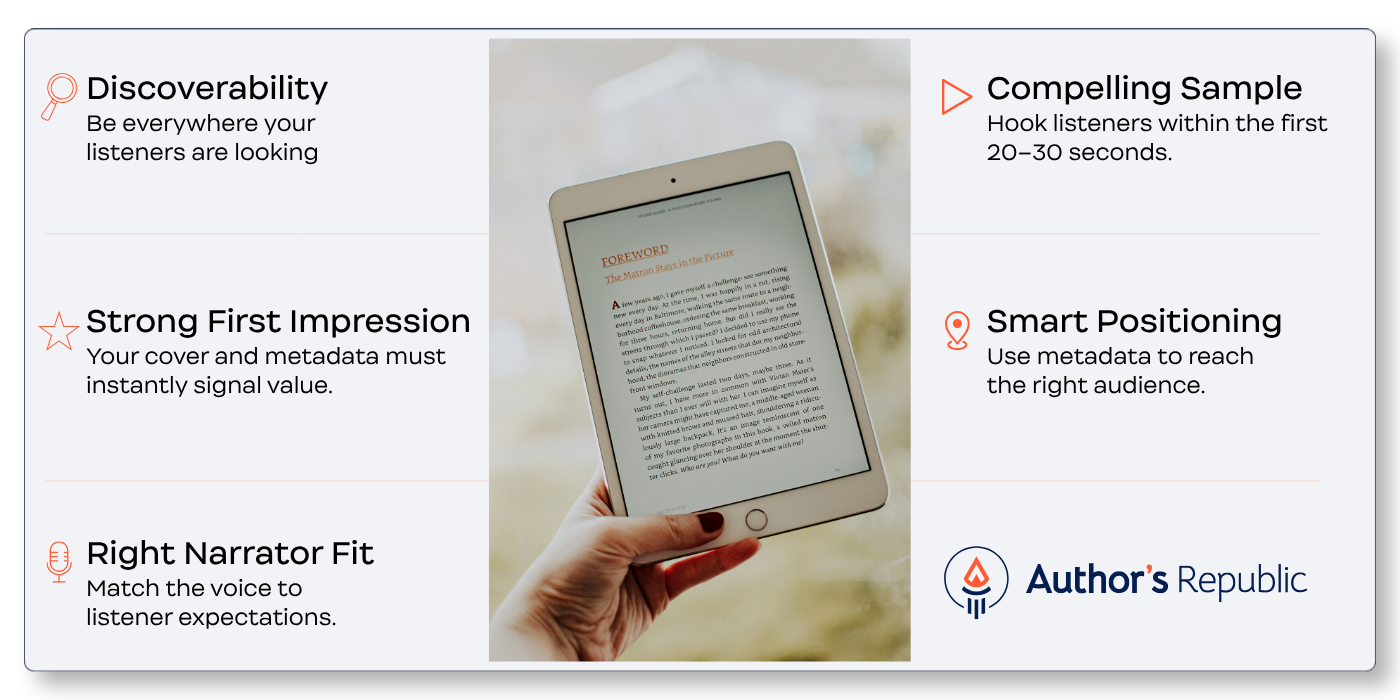
They’re easy to discover
Before anything else, listeners have to find your audiobook.
That might happen through word of mouth, reviews, podcasts, influencer lists, or even a narrator’s following on social media. But one of the biggest drivers is availability. The more platforms your audiobook is on—and the better it’s positioned within those storefronts—the more opportunities it has to appear in search results, recommendations, and curated lists.
They make a strong first impression before the sample even plays
Before pressing play on your sample, listeners are making quick decisions.
They see your cover. They read the title. They might skim the description.
If those don’t clearly signal genre, tone, and the quality they’re looking for, most listeners won’t go any further. Strong packaging is what gets your sample heard.
They hook the listener fast with a compelling sample
Once someone hits play, the decision window is short.
Listeners often decide within the first 20-30 seconds whether they’ll keep listening. That means your opening needs to be clear, engaging, and sound professionally produced from the very first moment.
Audio quality, narration, and content all play a role here. If anything feels off—flat delivery, distracting noise, or a slow start—listeners drop off quickly.
They’re positioned correctly with strong metadata and merchandising
Top-selling audiobooks are easy for the right audience to find.
Accurate genre selection, relevant keywords, and clear descriptions help retailers surface your audiobook to listeners who are already looking for something like it. Just as importantly, they help listeners quickly confirm: “Yes, this is for me.”
They use the right narrator for the audience—not just the author
Narration isn’t just about having a good voice—it’s about having the right voice.
Top-performing audiobooks align narrator tone, pacing, and delivery with listener expectations in that genre. A strong narrator keeps listeners engaged, handles dialogue seamlessly, and maintains consistency from start to finish.
Now that you understand how listeners discover and choose audiobooks, the next step is execution—how to make sure your audiobook delivers at each of these stages.
How to make an audiobook that performs at every stage
If you’re serious about creating an audiobook that can compete in today’s market, it comes down to creating a plan and making deliberate choices. From writing the manuscript, to production and distribution, to marketing and promotion, here’s where to focus your efforts.
1. Adapt your manuscript for audio
Audio is a different experience than reading. Before recording, review your manuscript with the listening experience in mind. Look for areas that may not translate well when spoken aloud:
- Break up dense, clunky sentences that are difficult to follow when heard
- Simplify repetitive phrasing or descriptions that can feel redundant in audio
- Search for references to page numbers, images, or visuals (use Ctrl + F) and revise them, remove them, or add them to a downloadable PDF. Note: not all retailers will accept PDFs.
- Convert charts, graphs, or visual elements into spoken explanations—or direct listeners to your website for reference
- Remove or flag any sections you don’t want included in the audiobook, and communicate those decisions clearly to your narrator
Read sections out loud, record yourself, and listen back, or use a basic text-to-speech option to read your manuscript to you. If something feels awkward or hard to follow, it will likely sound the same to listeners.
Many authors focus on how to write a bestselling book, but it’s also important to consider how that story performs in audio. This step ensures your title is built for listening—not just reading.
2. Cast a narrator based on listener expectations
Choosing a narrator is one of the most important decisions you’ll make.
Focus less on personal preference and more on what listeners in your genre expect. Study top-selling audiobooks similar to yours:
- Tone (warm, intense, conversational)
- Pacing (fast-moving vs. measured)
- Delivery style (subtle vs. expressive)
Using the Author’s Republic Marketplace, you can request custom auditions using real scenes from your book. Pay attention to clarity, emotional range, and how naturally they handle dialogue.
3. Ensure your audio meets professional standards
Listeners expect clean, consistent audio—and they’ll quickly notice when something is off.
Common issues like uneven volume, background noise, or noticeable edits can lead to poor reviews or early drop-off. Before submitting your audiobook for distribution, make sure your audiobook meets all required audio specifications.
Test your audiobook across multiple environments—headphones, cars, and smart speakers—to ensure quality holds up everywhere.
4. Optimize your metadata for discovery
Even a great audiobook won’t perform if it’s hard to find.
Metadata—your categories, keywords, and description—plays a major role in how retailers surface your audiobook.
Focus on:
- Accurate genre selection
- Eye-catching descriptions
- Keywords
- Positioning that matches listener expectations
If your metadata is vague or misaligned, your audiobook may never reach the right audience.
Learn more about optimizing metadata.
5. Distribute widely to maximize reach
Listeners don’t all use the same platform.
Some rely on subscription apps, others purchase individually, and many discover audiobooks through regional storefronts or curated recommendations.
Limiting your audiobook to a single retailer limits your visibility.
Wider distribution:
- Increases discoverability across platforms globally
- Expands your potential audience
- Creates more opportunities for algorithm-driven recommendations
How to compete with top-selling audiobooks—without a big budget
The audiobook market is growing—and so are listener expectations.
Big budgets can help, but they’re not what make an audiobook succeed. What really matters is how it’s put together, how it’s positioned, and how it connects with listeners.
Strong discoverability, clear positioning, compelling samples, and the right narrator all play a role.
Authors who understand how to make an audiobook for listeners—not just readers—are the ones gaining traction across platforms. With the right approach, your audiobook can stand out, reach new audiences, and build long-term momentum.